


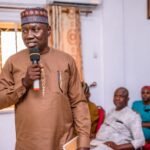

Hon. Mai Mala Buni is widely regarded as one of the most influential political figures to emerge from northeastern Nigeria in recent decades. Born on 19 November 1967 in Buni Yadi, Gujba Local Government Area of Yobe State, he rose from modest beginnings to become a prominent politician, businessman, and administrator. Since 29 May 2019, he has served as the Executive Governor of Yobe State, where he has pursued reforms aimed at strengthening governance, revitalizing social services, and promoting inclusive development.
His leadership style combines grassroots political engagement with pragmatic administrative reforms. Over the years, Buni has built a reputation as a consensus builder and loyal party strategist, particularly within the All Progressives Congress (APC), where he once served as National Secretary and later as Chairman of the Caretaker/Extraordinary Convention Planning Committee.

Childhood and Early Education
Mai Mala Buni was born into a family engaged in trade and transportation, which exposed him early to the values of entrepreneurship, diligence, and community responsibility. His upbringing in the Kanuri cultural environment also shaped his worldview, emphasizing discipline, humility, and respect for communal leadership structures.
Like many children in Northern Nigeria, his earliest education began with Qur’anic studies, where he memorized parts of the Holy Qur’an under the guidance of local Islamic scholars. This religious grounding later influenced his leadership ethos and emphasis on moral responsibility in public office.
He later enrolled at Buni-Gari Central Primary School, where he obtained his First School Leaving Certificate in 1979. After completing primary school, he proceeded to Government Secondary School, Goniri, graduating in 1985 with the West African Examination Council certificate.
Although he became deeply involved in business and politics after secondary school, Buni later pursued higher education as a mature student. His educational pursuits include:
• Diploma in Vocational and Technical Studies from the College of Vocational Science and Technology (2012).
• Bachelor of Science (BSc) in International Relations from Espan Formation University, Benin Republic (2014).
• Master of Arts (MA) in International Relations from Leeds Beckett University, United Kingdom.
His academic background in international relations helped shape his understanding of governance, diplomacy, and public policy.
Professional and Business Career
Before entering full-time politics, Buni developed extensive experience in entrepreneurship and private-sector management. Growing up in a family involved in commerce and transport, he quickly acquired business acumen and established several enterprises across different sectors.
Over time, he chaired or served on the boards of several companies, including:
MBG Integrated Farms Ltd, MMB Petroleum and Chemical Company Nigeria Ltd, MBG Construction and General Services Ltd, Buni Gari and Company Nigeria Ltd, Bright View Capital Alliance Ltd, Subi Mega Global Solutions Ltd, Rehab Synergy Nigeria Ltd, First Integrated and Logistics Services Ltd.
These ventures spanned agriculture, petroleum, logistics, construction, and services, giving him managerial experience that later influenced his governance style.
His business background is often cited as a factor behind his focus on economic development, entrepreneurship, and job creation in Yobe State.
Political History and Rise to Power
Early Political Involvement
Mai Mala Buni’s political career began in 1992, when he was elected Councillor representing Buni Ward in Gujba Local Government Council under the National Republican Convention (NRC). He later rose to become the Speaker of the council, marking his first leadership role in government.
Following Nigeria’s return to democracy in 1999, Buni continued his political engagement and worked as Senior Legislative Assistant in the National Assembly (2000–2004) and Member of the Governing Council of the University of Uyo (2004–2007). These positions strengthened his experience in legislative affairs and policy coordination.
He gradually became a prominent figure in opposition politics in northern Nigeria. His party leadership roles include: Chairman, Action Congress (AC) in Yobe State (2006–2010), Protem Secretary of the APC in Yobe State after the merger of opposition parties (2013), State Chairman of the APC (2014), National Secretary of the APC (2014–2019).
As APC National Secretary, he played a strategic role in the party’s historic victory in the 2015 general elections, which brought Muhammadu Buhari to power and ended the long dominance of the People’s Democratic Party at the federal level.
In 2020, he was appointed Chairman of the APC Caretaker and Extraordinary Convention Planning Committee, where he oversaw reconciliation and reorganization within the ruling party during a period of internal crisis.
Buni contested and won the 2019 Yobe State governorship election under the APC platform and assumed office on 29 May 2019, succeeding Ibrahim Gaidam.
His administration is guided by the philosophy of continuity, consolidation, and innovation in governance.
Reforms and Development Initiatives in Yobe State
Education Reform
Education has been one of the central pillars of Buni’s administration. Shortly after assuming office, he declared a state of emergency in the education sector to address the challenges of poor infrastructure, teacher shortages, and low enrollment.
Major reforms include:
• Construction of modern mega schools across the state to reduce overcrowding.
• Rehabilitation of dilapidated school buildings.
• Provision of textbooks, laboratory equipment, and ICT facilities.
• Recruitment and training of teachers to improve the quality of education.
• Expansion of the school feeding program to encourage school attendance.
• Sponsorship of hundreds of students for overseas studies in countries such as India and other nations.
These initiatives aim to reduce the number of out-of-school children and improve educational standards in the state.
Healthcare Reforms
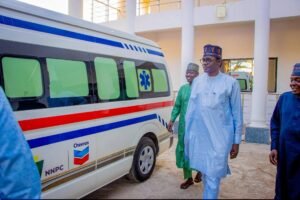
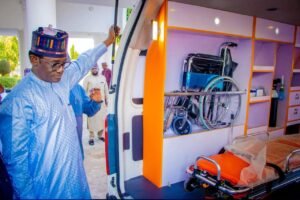
The Buni administration has invested heavily in strengthening healthcare infrastructure and service delivery across Yobe State.
Key interventions include:
• Construction and renovation of hospitals and primary healthcare centres.
• Provision of modern medical equipment in state hospitals.
• Recruitment and training of health personnel.
• Special focus on maternal and child healthcare programs.
• Upgrading facilities to reduce the need for patients to travel outside the state for treatment.
These reforms are designed to improve access to healthcare services and reduce preventable deaths.
Infrastructure Development
Infrastructure expansion has been another cornerstone of Buni’s governance strategy. His administration has initiated several projects aimed at improving connectivity, economic growth, and urban development.
Major infrastructure initiatives include:
• Completion of the Yobe International Cargo Airport project.
• Construction of modern markets to stimulate trade and commerce.
• Large-scale housing development projects, including about 2,300 housing units.
• Road construction and rehabilitation across major towns and rural areas.
These projects are intended to attract investment and stimulate economic activities in the state.
Youth and Women Empowerment
Recognizing the importance of human capital development, Buni has implemented programs aimed at empowering young people and women economically.
Key initiatives include:
• Entrepreneurship and skills acquisition programs for youth.
• Financial support schemes for women-owned small businesses.
• Agricultural empowerment initiatives targeting rural youth.
• Educational scholarships and vocational training programs.
Such initiatives are aimed at reducing unemployment and promoting economic self-reliance.
Governance and Administrative Reforms
Governor Buni’s leadership approach emphasizes inclusive governance, political stability, and peacebuilding.
Notable governance initiatives include:
• Strengthening collaboration between traditional institutions and government.
• Improving transparency and accountability in public administration.
• Promoting political reconciliation within party structures and across communities.
• Implementing development policies aimed at improving living standards across the state.
His governance philosophy focuses on people-centered policies and long-term institutional development.
Awards and Recognition
In recognition of his contributions to governance and public service, Mai Mala Buni has received several honors, including: Commander of the Order of the Niger (CON) national honor, Awards for good governance, transparency, and leadership from various organizations.
The political trajectory of Mai Mala Buni illustrates the rise of a grassroots politician who combined business experience, party organization skills, and public administration to become one of the most influential leaders in northeastern Nigeria.
From his early days as a local councillor to his national role within the All Progressives Congress and his tenure as Governor of Yobe State, Buni has demonstrated resilience, strategic political acumen, and a commitment to developmental governance.
Through reforms in education, healthcare, infrastructure, and economic empowerment, his administration has sought to transform Yobe State into a more stable and prosperous society.
Indeed, his humility and candor is worth emulating.